
What a Salon Near Kohler, Wisconsin Taught Me About Ageism and Strength
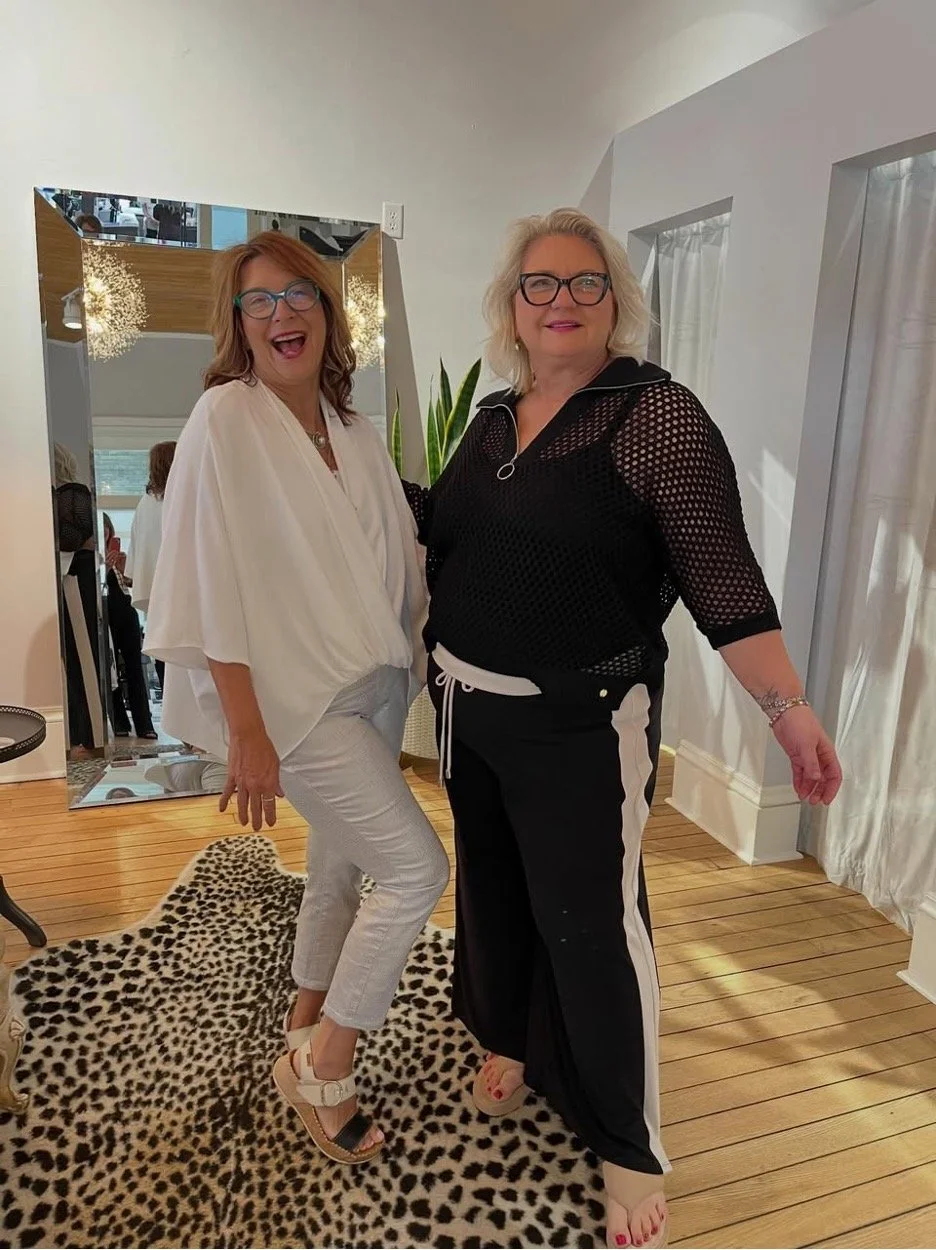
Kathryn and Vicky, mid-setup for a trunk show. Sixty and sixty-three. Nobody in this photograph is slowing down. Photography courtesy of K Lorraine Salon.Spa.Boutique.
Age as asset. What women who build in their sixties can teach the rest of us about confidence, visibility, and freedom.
This is not a beauty story.
It isn't a self-care story either — no candles, no "treat yourself," no soft-focus nonsense about slowing down.
This is a story about age, agency, and visibility. About two women who put a name on a storefront window in their fifties, and are still betting on themselves in their sixties. And about why the woman who books a solo flight to the Osa Peninsula and the woman who signs a commercial lease in a small Wisconsin town are, in the end, the same woman.
Meet Kathryn Hillstrom, 60, and Vicky LeMahieu, 63.
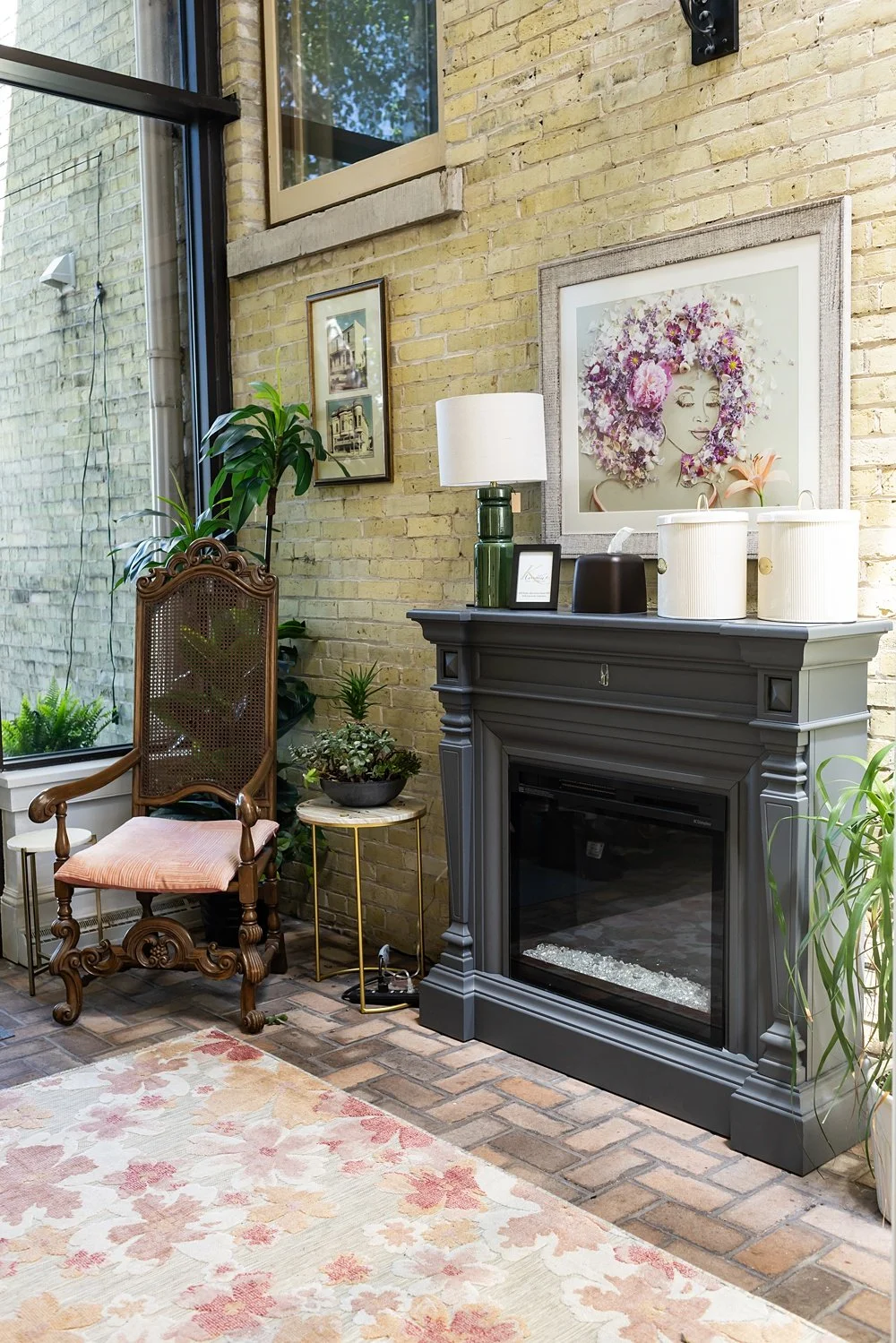
Original cream brick, left exposed. We restore old buildings because time gave them something new construction can't buy. Photography courtesy of K Lorraine Salon.Spa.Boutique.
The Town That Asks You to Slow Down — and the Women Who Never Did
Most travelers come to this corner of Wisconsin for Kohler. The American Club. The golf. The spa weekend. The dinner reservation downtown, a few blocks off the Lake Michigan pier. Then they drive home.
Go a few minutes up the road instead, into the Central Business District of Sheboygan Falls, and the pace changes on purpose. It's pleasantly unhurried — a National Register district where the streets still invite you to notice things. Cream brick and limestone. Storefronts with their original bones. The gentle rhythm of a place that decided, decades ago, that its old buildings were worth keeping.
That's the first quiet argument this town makes: age is not a liability. Age is provenance.
We restore historic buildings because time gave them something new construction can't buy. We celebrate the brickwork, the wear, the endurance. Then we turn around and treat women who have accumulated the exact same thing — decades, evidence, survival — as though they've depreciated.
The building at 202 Pine Street holds both ideas at once.
When Vicky talks about what they did here, she doesn't start with the chairs or the color line. She starts with the building — all floors covered, then brought to life. Every level of it theirs. Not one storefront carved out of a larger vacancy, but the whole structure, occupied, lit, in use.
That's a phrase worth keeping, because it describes more than square footage. Most of us are running one floor. We keep the ground level open for company and leave the rest shuttered — the ambition, the appetite, the plans we keep meaning to get to. Vicky and Kathryn looked at an old building and refused to accept partial occupancy. Then they built a business on the same principle.
Historic brick outside. Two owners inside who are living proof that enduring presence is the whole point.
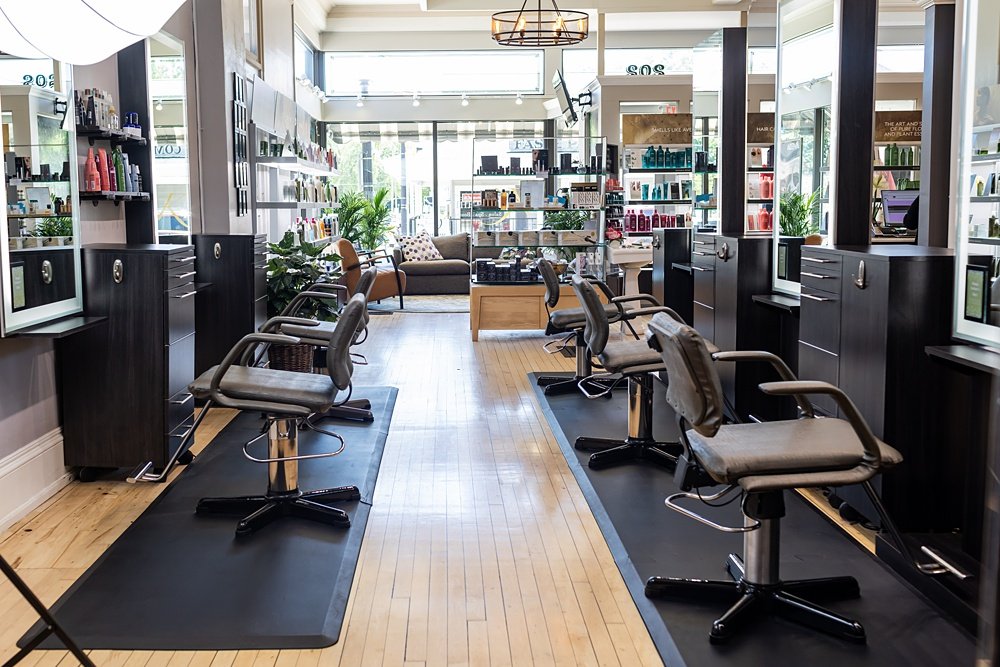
Stylists in their twenties working the same floor as stylists in their sixties. Both directions are teaching. Photography courtesy of K Lorraine Salon.Spa.Boutique.
Walking In
Step through the door and the casual energy of a neighborhood stroll gives way to something immediate: belonging.
The space is calm, polished, deeply personal. Aveda Concept Salon, full spa, a boutique tucked in beside it. But what you register first isn't the décor — it's the temperature of the room.
"Make them feel beautiful all the way around," Kathryn says.
All the way around. Not the front-facing version. Not the version that's presentable for other people. The whole circumference of a woman — what she sees in the mirror, what she carries in, what she walks back out into.
That balance is not an accident. It's the culture, and the culture is the product.
Vicky describes the team as a collective — stylists educating each other, skill moving in every direction across the floor. Which sounds like ordinary good management until you notice what it quietly dismantles.
Because there is age diversity here. Women in their twenties and women in their sixties working the same floor, and no one has assigned them fixed roles in the transaction. The newest stylist brings technique that didn't exist five years ago. The veteran brings forty years of hands on real heads of hair — the judgment you cannot download, the read on a client who says she's fine and isn't.
Both directions are teaching. Both directions are learning.
That is the entire argument of this piece, playing out on a salon floor in Sheboygan Falls every single day.
Ageism survives on a one-way arrow: the young acquire, the old decline, and somewhere in between a woman crosses from asset to overhead. Point the arrow both ways and the whole thing collapses. Not with a speech. With a schedule, a training model, and two owners who decided that experience and freshness are not competitors.
Women of every age are in these chairs. Twenty-somethings before a wedding. Mothers on a rare hour alone. And women in their sixties, seventies, and beyond who are not being handled, humored, or hurried.
"Respectfulness is protected," Kathryn says — and Vicky's collective is how you protect it. Guarded like a policy. Like a load-bearing wall.
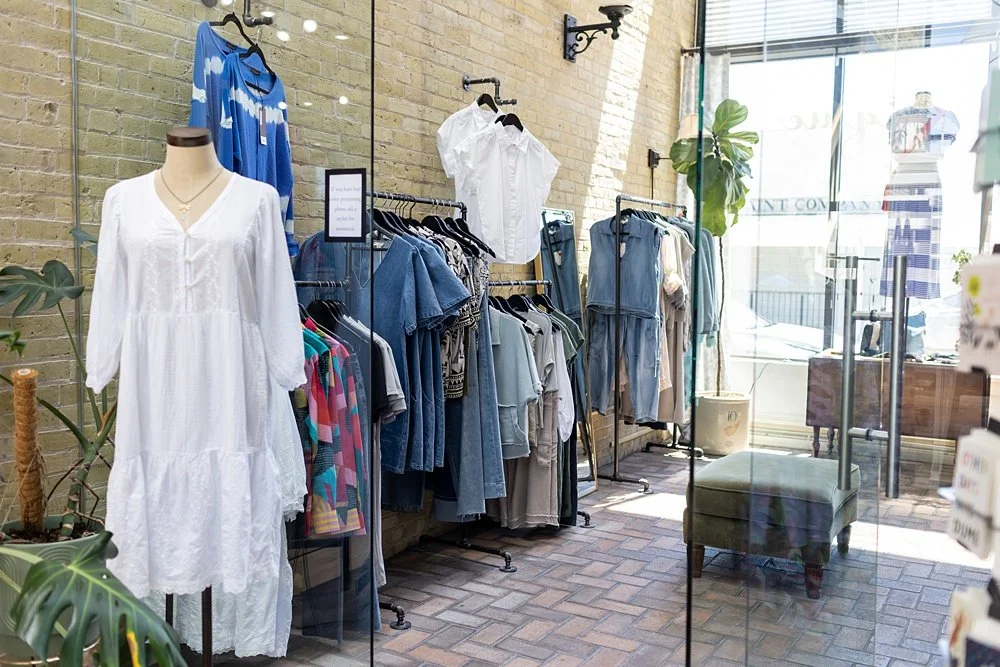
The boutique. Every service they wanted to add needed square footage the old space didn't have. Photography courtesy of K Lorraine Salon.Spa.Boutique.
Outgrowing the Room
Ask why two women in their fifties would take on a lease, a renovation, and a payroll, and Vicky gives you one word.
Stifled.
Not by anyone. That's what makes this story unusual — and, I'd argue, more useful.
I was in the old space. It was lovely. Tasteful, well-appointed, clearly run by people who cared about the details. Nothing was wrong with it. It had simply stopped being big enough. You could feel it in the way the rooms had been asked to do double duty, in the sense that ideas were being scaled down to fit the floor plan.
That's a particular kind of constraint, and women recognize it instantly: the container is fine, and you have outgrown it. Every service they wanted to add needed square footage that didn't exist. Every new thought arrived pre-shrunk.
The default story about ambitious women comes with an antagonist — someone in the way, someone who has to be outmaneuvered. This isn't that story. The pressure here came from their own growth pressing against their own walls, which is a better problem and a harder one. There's no one to blame and nothing to wait out. Nobody is going to change their mind and hand you more room.
You either go get it, or you stay small.
They went and got it. 202 Pine Street offered what the old building couldn't: room to expand. A salon, a full spa, a boutique, space for wellness education — and floors that weren't spoken for yet.
Most people respond to stifled by shrinking to fit. A smaller number decide the container is the problem.
Kathryn and Vicky signed a lease.
That's the part I want you to hold onto. They didn't trim the vision down to match the floor plan. In the decade when women are most routinely written off as coasting toward the exit, they went looking for a bigger building.
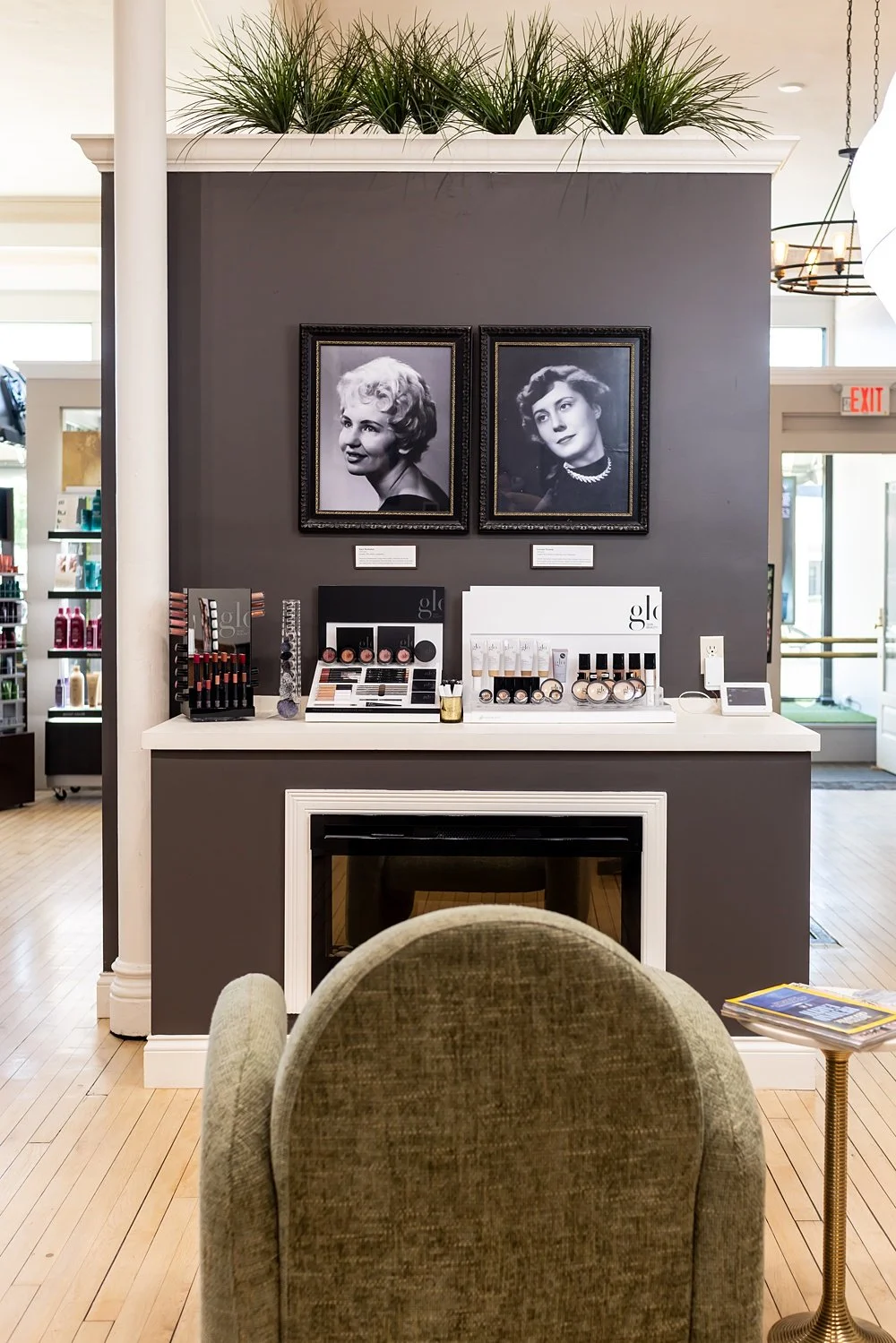
Kay on the left, Vicky's mother. Lorraine on the right, Kathryn's. They hang in the middle of the salon, watching over every client who walks in. Photography courtesy of K Lorraine Salon.Spa.Boutique.
Named for Their Mothers
Here's the detail that stopped me.
K Lorraine is named for Kaye and Lorraine — Vicky's mother and Kathryn's mother. Two women who taught their daughters to talk, to walk, to run, and eventually to dream bigger than the room they were standing in.
Think about what that means on a storefront window in 2018. Two women in their fifties opened a business and chose to put older women's names on it. Not something aspirational and abstract. Not something that tested well. The names of the women who came before them.
And they didn't stop there. The KLorraine Cosmetology Scholarship sends a Sheboygan County graduating senior toward her own license, her own chair, her own eventual lease — up to $2,500 toward tuition.
So the lineage runs the full length: mothers honored, daughters funded, and two founders standing in the middle holding it together.
That is what durable looks like. Not a business that survives. A business that transmits.
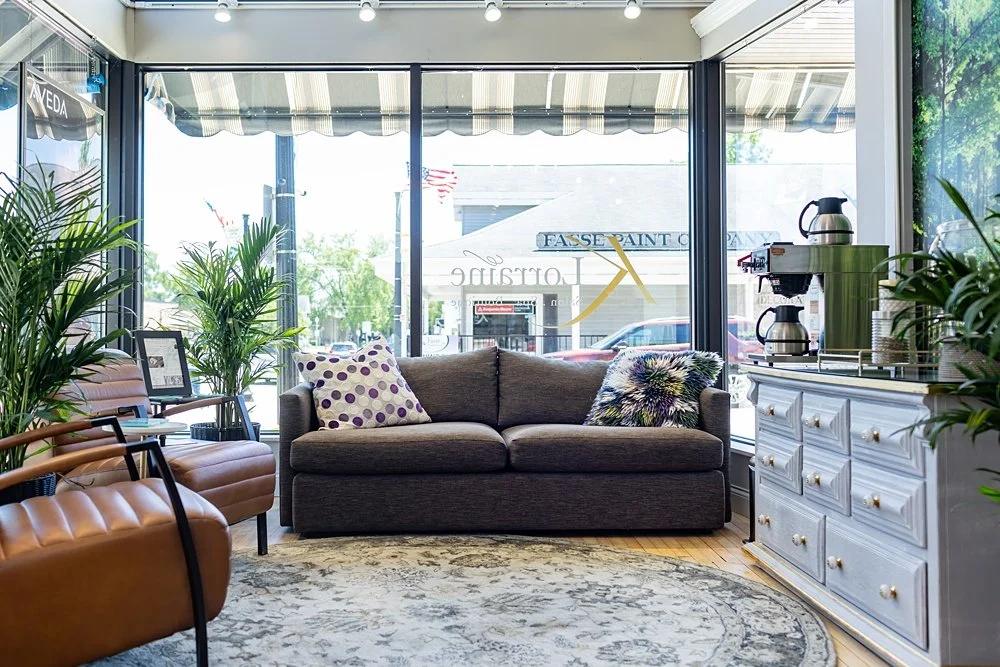
202 Pine Street. Coffee's on. Photography courtesy of K Lorraine Salon.Spa.Boutique.
Why I Care About This on a Travel Blog
Because it's the same muscle.
The woman who signs a commercial lease at 55 and the woman who boards a single-engine turboprop alone at 69 are running identical software: I have assessed this. I am capable. I do not require permission.
And they get underestimated in identical ways.
The same women who travel alone, navigate the world wisely, and make their own decisions are exactly the women ageism tends to underestimate.
Guests young enough to be my children tried to take my surfboard out of my hands. I didn't let them. Kathryn and Vicky opened a business at the exact age the culture assumes you start winding down. Different settings. Same reflex — the assumption that a woman past a certain birthday is winding down rather than gearing up.
We are not winding down. We are the most experienced version of ourselves that has ever existed.
What I Actually Mean by Ageism
I use the word to describe more than discrimination.
I mean the subtle expectation that after a certain point, we're supposed to get smaller. Less daring. Less visible. Less present. Ageism treats independence after 60 as suspect and ambition as misplaced — a little unseemly, a little much, bless her heart.
We refuse both ideas.
What It Looks Like: A Pickup Bed in Nicaragua
Let me show you what it actually looks like.
A surf camp on Nicaragua's Pacific coast, three seasons back. The protocol there is the protocol everywhere: you carry your own board. Down to the water, back up the sand, into the truck at the end of the day. Nobody is your porter. That's the deal.
The staff honored it completely. The Nicaraguan instructors were superb athletes and serious professionals — elite swimmers with sharp ocean knowledge, generous and precise, fully prepared to pull anyone out of trouble. They coached me like a surfer.
The guests were a different story.
Surfers I'd put in their early thirties kept reaching for my board. Going down to the water, coming back up, at the truck. Not asking — reaching.
And here's what they got wrong. A seven-foot soft-top is not light. Hoisted overhead and carried any real distance across sand, it's a genuine load — you have to be in shape to do it, which is exactly the point. I am in shape. I have the upper-body strength to pop up on a wave, harder work by far than the walk to the water. The task was never easy. I was simply equal to it.
I didn't let them. Every time, I kept my hands on my own board.
Then there was the truck — a rust-spotted Toyota pickup, boards stacked above the rails, wooden benches in the bed, steep dirt roads above the Pacific. Riders took the benches in turns. When my turn came, I took it. And those same guests got confrontational. Not concerned. Confrontational — about whether I belonged back there at all.
Then one of them asked my age. Not warmly, not out of curiosity, but in the tone of an interrogation. A question deployed as a challenge, the way someone asks for ID at a door you're already walking through.
I was 66. I'd have told anyone who asked kindly.
Not one of them thought they were doing anything but being kind. That's precisely the problem. Unrequested help is not neutral. It quietly relocates you from participant to cargo, and it does it in front of everybody, so the whole camp revises its estimate of you at once.
I held my ground all week. I rode in the truck bed. I carried my own board every single time.
And then I booked my next season somewhere else.
Let me be precise about why, because the honest version matters more than the tidy one. It was not the politics. Not then. Nicaragua stayed on my list for three more years — I wrote about León and Granada and sent you there gladly, and I'd have gone back in a heartbeat. It wasn't until three months ago that I started telling you not to go, and that decision has nothing to do with a truck bed and everything to do with an authoritarian government. That's a separate grief, and I've written about it elsewhere.
No. I went looking for a different camp because of the guests.
Not because they beat me. They didn't — I never once let go of that board. I left because a week spent proving I could carry my own equipment is a week I couldn’t focus on the waves like I wanted to. Because standing your ground shouldn't be the workout. Because I have a finite number of seasons in the ocean, and I am not spending any of them being appraised by strangers.
That is a small, unglamorous act of consumer power, and I want you to see it clearly: I took my money down the road.
Remember what Kathryn said, four miles from Kohler: respectfulness is protected. That truck bed is what an unprotected room feels like. Nobody was cruel. Nobody had to be. There was simply no one whose job it was to defend the assumption that I was capable — so the assumption evaporated, and I spent a week hanging onto my own board like it was a title I had to keep proving.
What It Looks Like When Someone Protects It: A Beach in Panama
So I found the place where it is protected.
Playa Venao, Panama. Beach Break Surf Camp, and a surf director named Brent Hoffman who welcomes surfers of every ability and fitness level without ceremony, and coaches you where you actually are — not where a curriculum assumes someone your age should be. I've started seasons three, four, and five on that beach, and I'll start season six there too.
Brent coaches the surfer in front of him, not the one he expects to find there. Whether you can hold a full session is something he assesses, in the water, in real time. It is not something he decides in advance based on the year you were born. The rest is earned at home, in the ordinary weeks between trips.
Brent has never once made me feel behind. The work is simply the work, and he meets it where it is.
Now here's what I want you to notice, because it's the distinction almost nobody makes.
Brent takes my board out of my hands more often than those guests in Nicaragua ever did.
They're his boards. They're expensive. He's usually running straight from my session into the next one, and I always offer — let me rinse it, let me coil the leash — and he waves me off, because it's faster if he just does it. That's the entire transaction.
It has never once felt like being handled.
The difference isn't the act. It's the reason. Brent is moving his own equipment on his own schedule. Those guests were making a decision about me — about what my body could do — and then acting on it without asking. One is logistics. The other is a verdict.
Here's the test, and you can run it anywhere:
Does the help reflect something about the helper's job, or something they've decided about your body?
And Brent guards the second thing absolutely. He has never allowed another guest to patronize me, reach for my board, or appoint themselves the authority on my limits. My last session was with two men my own age — warm, easy, entirely respectful company. That wasn't luck. That's what happens when the person running the beach sets the tone and holds it.
Which is exactly what Kathryn meant. Respectfulness is protected. A surf director in Panama and two salon owners in Sheboygan Falls are running the same policy, in the same way, for the same reason.
Culture is not ambient. Somebody builds it on purpose and then defends it. Kathryn and Vicky built theirs into a training model. Brent built his into how he runs a surf school.
And when a place doesn't have it, we are not obligated to keep showing up and paying for the privilege of proving them wrong. There is always another beach.
The Rest of It
Solo travel after 60 demands visibility, not invisibility. Traveling alone is an invitation to walk into unfamiliar places with your whole self intact. To say, with your posture and your presence: I am here. I am capable. I still belong in this conversation, this street, this café, this landscape, this story.
There is room in that for prudence. There is no room in it for erasure. Room for independence, none for isolation. Room for aging — never for disappearing.
And visibility isn't only about who gets to travel. It's about who gets to build. Who gets the loan, the lease, the benefit of the doubt, the assumption of competence. Women over 60 deserve to see themselves reflected as vibrant, capable, travel-ready — and as founders.
How Travel Brands, Hotels, Salons, and Cities Can Do Better
|
|||||||||||||||||
Helpful structure is not the enemy. When I traveled through India, a vetted guide and driver didn't diminish the experience — they unlocked it. There's a world of difference between support I chose and care I never asked for, delivered as though I were fragile cargo.
And What We Can Do — With Our Money
Here's where this comes back to you.
We already know to buy local. We already know to seek out women-owned. I'm asking for one more filter on top:
Do business with the women who are visibly refusing to shrink.
The 58-year-old who just opened a bakery. The 63-year-old who runs the tour company. The two women whose names are on a historic storefront on Pine Street. Every dollar that lands in those registers is a data point arguing that betting on yourself in your sixties is not a cute story — it's a sound investment.
The same rule runs in reverse. G Adventures restricts an entire tour line — 18-to-Thirtysomethings — to travelers aged 18 to 39. Not a fitness standard. Not a pace rating. A birthday. For years that meant certain destinations on their roster were reachable only by people under forty. Some of those caps have since come down, and I'll credit that. But I don't book with operators who sort travelers by birth date, and I'll say so plainly. Sell me a pace. Sell me an elevation profile, a daily mileage, a difficulty rating I can honestly assess myself against. Do not sell me a birthday.
Spending is a vote. Cast it for longevity.
I've cast mine. Away from one surf camp, toward another. Away from an operator that sorts by age. None of it was dramatic. All of it was a choice.
Three ways to start this week:
1. Book the appointment, buy the thing, leave the review. Name the owner. Say her name out loud in public.
2. Push back on one small erasure. The compliment with the qualifier. The staffer who asked your daughter the question. Say something, kindly, once.
3. Pass this to the woman in your circle who's hesitating — over a lease, over a flight, over a chair she's finally ready to claim.
Come
To every woman over 60 reading this — the one who thinks the window has closed. The one wondering whether it's too late to start something, go somewhere, or take up this much space:
I see you. I was you.
Confidence isn't a personality trait handed out at birth. It's built — through boundaries you hold, presentation you choose deliberately, and a self-trust that compounds every single time you keep a promise to yourself.
You don't need permission to travel alone. You don't need permission to open the doors of your own business. You don't need permission to be seen exactly as you are, right now, with the decades showing.
Walk into the room like the historic building you are. Original bones. Every floor occupied. Every light on. In its absolute prime.
We're not done dreaming. We're just getting started. 🌿
Have you built something after 60 — or is it still sitting in a notebook? Drop a comment below. And if this post pushed you one step closer, pass it to the woman in your circle who's ready to grant herself permission.
"Pack light. Step bold. Feel deeply."
Visit: K Lorraine Salon.Spa.Boutique — 202 Pine Street, historic downtown Sheboygan Falls, WI · 920.550.2533 · klorrainesalon.com · Salon, full spa, boutique, and wellness education. Four miles from Kohler, and worth the detour.